
Certified Turkish-Arabic Translation for Business and Personal Use
Certified Turkish-Arabic translation in Saudi Arabia for business and personal documents, with accurate names, dates, numbers, data, and official records.

Certified Turkish-Arabic translation for commercial and personal documents requires handling every document according to its actual function because a Turkish birth certificate is not the same as a commercial contract, a marriage certificate is not the same as a company registration document, and a supply agreement is not the same as an invoice or authorization letter. A Turkish file may contain names written with special characters, official stamps, electronic references, and family or business information that must be transferred accurately into Arabic. Most importantly, translation is not automatically a substitute for authentication, Apostille, or document verification. Professional work therefore begins by identifying the document type, the Saudi receiving authority, and the intended use before standardizing names, numbers, and dates and translating the complete content without changing its legal or commercial nature.
Certified Turkish-Arabic Translation
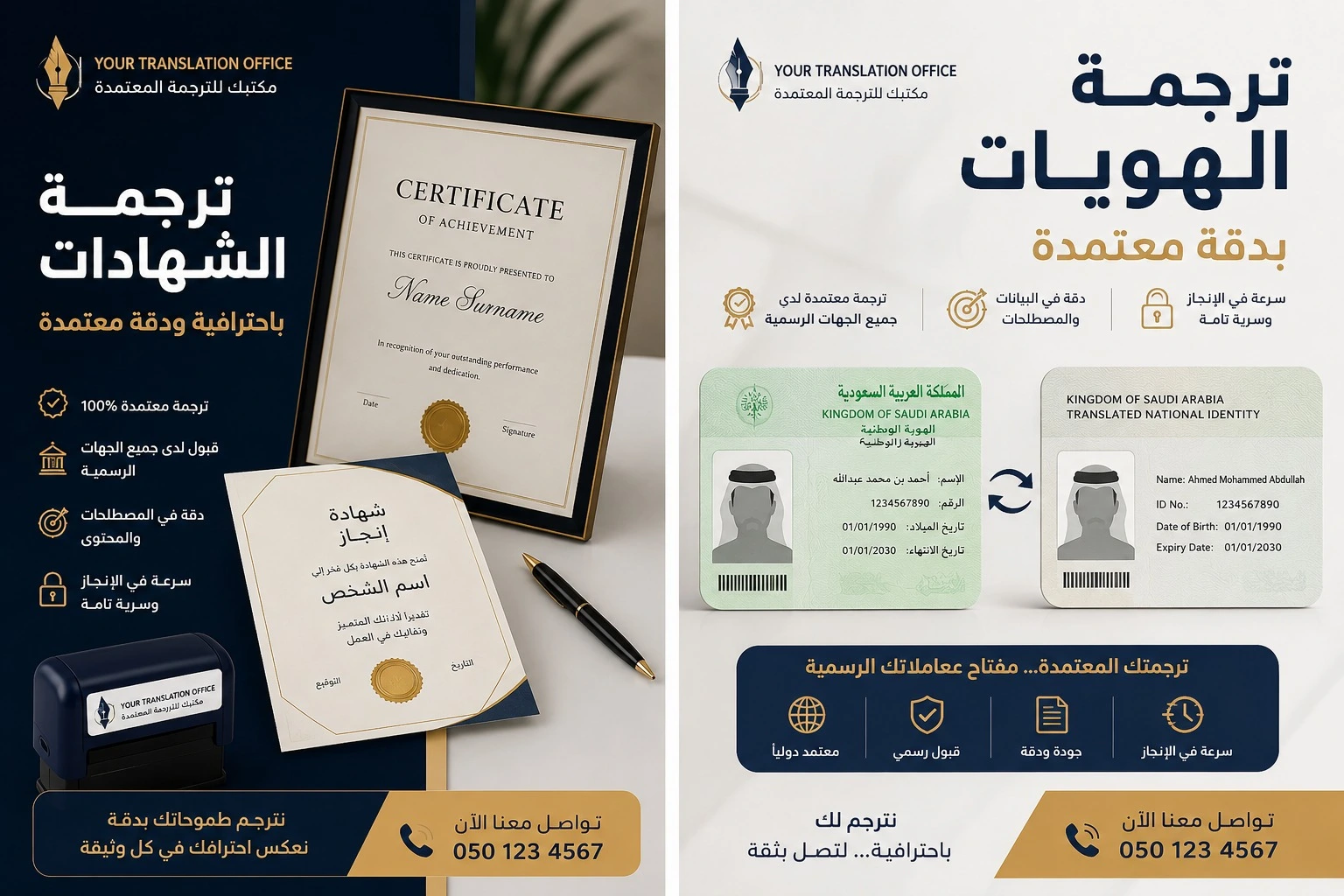
Certified Turkish-Arabic translation requires identifying the authority that will receive the document before translation begins because the word “certified” on its own does not define the complete procedure. The document may be needed for a personal transaction, company contract, commercial agency file, embassy submission, banking matter, or judicial procedure. Each case may require a different approach to the original document, authentication, certification, and presentation of the translation.
A particularly important issue with Turkish documents is the Apostille system. Saudi Arabia became a party to the Hague Apostille Convention and the Convention entered into force for the Kingdom on December 7, 2022, while Türkiye has been a party since September 29, 1985. This creates an Apostille route for public documents falling within the scope of the Convention between member states instead of the traditional chain of legalization in applicable cases. However, this should never be turned into a general rule stating that “every Turkish document carrying an Apostille is automatically accepted everywhere.” The document type and the Saudi receiving authority still matter.
This is where the translator’s role becomes important. If an Apostille is attached to the document, it should not simply be ignored or separated from the file without a reason. At the same time, the Apostille should not be treated as though it forms part of the substantive content of a birth certificate, agreement, or other document. Every element should be handled according to its actual function.
Turkish names require particular accuracy. Turkish uses characters such as ı, İ, ş, ğ, ç, ö, and ü, and a name that sounds simple may be written in Arabic in several possible ways. If the document holder has a passport, Saudi residency document, or previous Saudi record, those documents should be used as references to standardize the Arabic spelling rather than creating a new version that differs from the rest of the file.
Dates require similar attention. A Turkish document may contain an issue date, event date, registration date, and expiry date. These should never be combined under one heading merely because the table or form is compact.
Certified translation also does not mean correcting the source. If the mother’s name, father’s name, or date of birth is wrong in the Turkish original, the translator should not silently change it in the Arabic version even if the client provides the correct information. The original document should first be corrected by the issuing authority.
-
Before translation begins the document type intended use and Saudi receiving authority should be identified so the team can determine whether translation alone is required or whether the file is connected with an Apostille authentication or additional supporting documents
-
Turkish personal names should be standardized in Arabic using passports Saudi identity records or other official documents whenever available so the same person does not appear under several different spellings in one transaction
-
Certified translation reproduces the document as issued and does not give the translator authority to correct the source change its legal nature or guarantee acceptance by the receiving authority
Turkish-Arabic Translator in Saudi Arabia
Choosing a Turkish-Arabic translator in Saudi Arabia requires looking at the type of file rather than simply whether the translator knows Turkish. A translator who works every day with birth and marriage certificates may be highly experienced in civil-status documents but may need a different level of expertise for a manufacturing agreement, distribution contract, or Turkish company file containing commercial and financial annexes.
A strong translator begins with context. When working on a Turkish population registration document, names of family members, family relationships, and civil-status dates matter more than decorative Arabic wording. When working on a contract, binding verbs, amounts, periods, and termination conditions matter more. When translating an educational certificate, the institution name, qualification, specialization, and grades require the greatest attention.
For personal files, the translator should also understand the distinction between different Turkish documents. Türkiye’s current electronic Apostille system includes certain documents such as criminal records, court judgments, population registry records, birth certificates, death certificates, and marriage certificates. This is useful because it demonstrates that the phrase “Turkish personal document” does not refer to one type of paper. Each document has its own issuing source and legal purpose.
One sign of a professional translator is requesting the complete document. A cropped image can hide a verification number, seal, issuing authority, or important note. Some Turkish electronic documents also contain a verification code or electronic reference that forms an important part of the document.
The translator should not rely blindly on machine translation for legal or administrative terms. Some Turkish terms may appear easy to translate literally but require different Arabic equivalents depending on whether they are used in a civil-status procedure, administrative context, or commercial document.
Independent review is particularly important. Turkish official records are often dense with names, numbers, and dates arranged in tables. It is therefore better to separate linguistic review from data review.
Pricing depends on the number of pages, document type, specialization, table density, formatting requirements, certification type, and urgency. A one-page certificate is not comparable to a fifty-page contract or a family registry containing numerous names and dates.
-
The appropriate translator should be selected according to the actual document because civil-status records commercial contracts and academic certificates require different expertise and terminology even when Turkish is the source language in every case
-
The complete Turkish document should be provided with all pages seals and references so the translator does not produce an accurate translation of only one incomplete portion of the official file
-
Names numbers and dates should receive a separate review from linguistic editing because one incorrect digit or letter in an official name can be more significant than the style of an entire paragraph
Turkish Document Translation into Arabic

Turkish document translation into Arabic covers a very wide range of documents, which means one template should never be used for every file. A client may have a population registry extract, birth certificate, tenancy agreement, company registration document, court judgment, and educational certificate, and each one requires a different approach.
The first step is classifying the document. Is it a public document issued by a government authority, a private commercial document, a contract between parties, a certificate issued by an educational institution, or a personal-status record? This classification helps determine the terminology and understand whether Apostille or another authentication procedure may be relevant.
Türkiye operates an electronic Apostille system for certain official documents and also provides electronic verification of Apostille documents issued through the service. This can be useful in practice, but it does not remove the Saudi receiving authority’s right to define what it requires when the document is submitted in the Kingdom.
If the source document contains several pages, the translator should not select only the page that appears “important” and ignore the rest. A population registry record may contain additional family information, while a court judgment may include the operative ruling on the final pages. Missing a page can change the understanding of the entire document.
Seals, marginal notes, and official annotations also need careful treatment. Where a seal contains readable text identifying an authority, that content can be reproduced appropriately. An illegible signature should not be assigned a guessed name.
The translated layout should also avoid imitating a Turkish government document so closely that the Arabic version appears to be an original government-issued document. The objective is a clear translation that can be compared easily with the source.
Where the document will be used in a sensitive Saudi procedure such as marriage, inheritance, litigation, or power of attorney, the receiving authority’s current requirements should be reviewed directly because translation alone does not prove that all other procedural conditions have been satisfied.
-
Turkish documents should be classified before translation into personal commercial judicial educational and other categories so each type receives the appropriate terminology and review process
-
Every page visible note and official annotation should be reviewed because a section that appears secondary may contain a verification code operative ruling or family information that changes the meaning of the document
-
Translation formatting should make comparison with the source easy but should not imitate the government document in a way that suggests the translation office issued a new Turkish document in Arabic
Certified Turkish Contract Translation
Certified Turkish contract translation requires reading the full agreement before translation begins because a clause on the first page may define a term that appears dozens of times later. A translator working clause by clause without context may use different meanings for the same obligation.
The first step is reviewing the parties and the capacity of each party. Is the Turkish company acting as supplier, manufacturer, agent, or distributor? Is the individual signing as a manager, authorized representative, or another corporate officer? Capacity is not a decorative detail because it determines who assumes the obligation.
The subject matter, consideration, payment conditions, delivery terms, term, termination, renewal, and dispute-resolution provisions should then be reviewed. “May” is different from “must,” and “has the right to” is different from “undertakes to.” These differences are commercial and legal rather than stylistic.
Where the agreement will be used for registering a commercial agency in Saudi Arabia, more specific requirements can apply. The Ministry of Commerce requires a contract not drafted in Arabic to be translated into Arabic by an approved translation office and requires the agreement to contain information relating to the agency, territory, duration, renewal, termination, dispute jurisdiction, and the foreign company’s official name. Official guidance also explains that foreign contracts and related documents require certified Arabic translation within the commercial agency procedure.
Authentication remains a separate issue. In agency contracts where the principal is foreign, official requirements refer to authentication routes that may include the traditional legalization process or the Apostille Convention depending on the case. This is a clear example of why translation and authentication are not the same step.
Turkish contracts also require attention to amounts stated in Turkish lira or other currencies and to payment terms linked to an exchange rate, invoice, or defined event. The translator should never convert the currency independently.
If the contract contains both Turkish and English versions, the translator should not assume that the English version controls. The language clause should be reviewed before deciding which text is the source.
-
Party names and capacities should be standardized before translating the rest of the contract because changing a company description from manufacturer to supplier or agent to distributor can alter the commercial relationship
-
Payment term renewal and termination provisions should be reviewed together so the relationship between due dates and notice periods is not changed when Arabic sentences are restructured
-
Translation authentication and Apostille are three separate matters so an excellent Arabic translation does not replace the official procedure required for the original agreement where the receiving authority requires one
Turkish Personal Document Translation

Turkish personal document translation can include birth certificates, marriage certificates, death certificates, population registry extracts, criminal records, certain court judgments, and other civil-status documents. These files require a high level of sensitivity because they connect family names, dates, and personal relationships.
Türkiye’s electronic Apostille system currently supports a number of personal and public documents including criminal records, court judgments, population registry records, birth certificates, death certificates, and marriage certificates. However, the electronic service applies to the documents included in the system and should not be treated as a universal route for every Turkish document.
A population registry extract, for example, can contain several names and multiple civil-status events. It should not be reduced to only the applicant’s name where the source contains additional information required by the receiving authority.
Family relationships require accurate translation. A father is not the same as a guardian, a wife is not simply a partner, and information recorded about family members should not be replaced with broad generic descriptions.
Names are equally sensitive. If the person is Turkish and the name contains special Turkish characters, the passport should be reviewed before selecting the Arabic spelling for official use. If the file concerns a family with several individuals, name forms should remain consistent from the first page to the last.
An Apostille confirms the authenticity of the signature, official capacity, or seal within the scope of the Convention. It does not mean that the translator independently verifies the truth of every fact stated in the underlying document. Translation remains responsible for accurately transferring the content.
If the Saudi receiving authority requires another form of authentication or procedure, its current requirements should be followed rather than assuming that one process works for all transactions.
-
Family files benefit from an internal table of names family relationships and birth dates so the same individual or relationship does not change between one translated certificate and another
-
The existence of an Apostille does not turn the translation into verification of every personal fact because Apostille and translation each perform a separate function
-
A personal document should not be shortened according to the translator’s idea of what is important because the receiving authority determines which parts of the complete document are required
Turkish Certificate Translation into Arabic
Turkish certificate translation into Arabic requires identifying the type of certificate before selecting terminology. The document may be academic, professional, a birth certificate, marriage certificate, death certificate, or another official record. The Arabic word “certificate” is very broad, while the legal or practical function can be completely different.
For academic certificates, the focus should be on the institution name, specialization, academic qualification, graduation date, grade, and document number where applicable. A diploma should not be upgraded to a bachelor’s degree, and a training program should not be translated as an academic degree merely because a Turkish term has more than one possible linguistic interpretation.
Civil certificates such as birth, marriage, and death certificates follow a different path. Türkiye’s electronic Apostille service currently allows Apostille processing for certain documents including birth, marriage, and death certificates as well as population registry extracts.
Academic files also require a distinction between translation and qualification equivalency. Translating a Turkish certificate into Arabic does not mean the degree has been formally recognized or equated in Saudi Arabia. Equivalency or academic verification is a separate procedure handled by the competent authority.
The same principle applies to professional certificates. A training certificate does not become a license to practice a profession simply because it has been translated.
Seals and signatures should be described according to what is visible. Where the certificate contains a verification code or electronic reference, that information should be preserved.
From a pricing perspective, a one-page certificate may be straightforward, but if it is accompanied by a transcript, diploma supplement, or several pages, the volume of terminology and review increases. The complete document package should preferably be evaluated before pricing.
-
Qualification title specialization and educational institution should be translated according to the actual level stated in the source without upgrading the degree or adding academic recognition that does not appear in the document
-
Civil academic and professional certificates each require different terminology so the word certificate should not be treated as though it serves one function in every file
-
Translation of a certificate does not equal recognition in Saudi Arabia because translation qualification equivalency professional licensing and verification remain separate procedures depending on the document and purpose
Turkish Translation Office in Saudi Arabia

Choosing a Turkish translation office in Saudi Arabia requires confirming that the office understands the complete file rather than merely being able to convert one Turkish sentence into Arabic. If the project contains a contract, company certificate, and personal records at the same time, the office should classify the documents and assign each group to the appropriate translator or reviewer.
The first standard is genuine Turkish-language expertise. Turkish contains special characters, sentence structures, and naming conventions that can cause errors when a translator relies heavily on an intermediary language or machine translation.
The second standard is subject-matter expertise. Commercial agreements are different from civil-status certificates. A court judgment is different from an academic certificate.
The third standard is name management. A professional office asks for passports or other reference documents where Arabic name spelling is sensitive. It should not allow different translators to write the same name differently across the same project.
Review comes next. An official document should receive linguistic review and data review. Long contracts may also require terminology and cross-reference review.
Confidentiality is equally important in both personal and commercial documents. Family files contain sensitive information, while business contracts can contain prices, conditions, and customer information. Access should therefore be limited to the people who genuinely need the file.
Pricing depends on word count, page count, document type, number of seals and tables, specialization, certification type, and required turnaround. An office that gives one fixed price per page regardless of content may not reflect the substantial difference between a short certificate and a complex commercial agreement.
One professional sign is that the office does not automatically tell the client, “Every Turkish document needs an Apostille.” Instead, it reviews the document type and receiving authority and explains the difference between translation, legalization, and Apostille rather than selling unnecessary procedures.
-
A suitable office should create one reference list for names and terminology before starting so all translated documents remain connected rather than becoming separate and contradictory files
-
Asking about the document type receiving authority and intended use is a positive sign because official translation should not be handled identically for every certificate contract or company document
-
Pricing should be compared together with the service scope review formatting and certification rather than by page count alone because the nature of each page matters more than its apparent size
Turkish-Arabic Commercial Translation
Turkish-Arabic commercial translation requires understanding the transaction and communication style between the companies. A commercial file often begins before the contract with quotations, messages, specifications, and negotiations and later develops into a purchase order, invoice, and shipping documents.
A Turkish quotation should clearly preserve the price, currency, quantity, validity period, payment method, and delivery time exactly as stated. An estimated delivery date should not become a binding deadline if the source does not say so.
Where the price is in Turkish lira, US dollars, or euros, the original currency should be preserved. The translator should not convert it into Saudi riyals independently because currency conversion depends on an exchange rate and reference date.
Product names also need consistency. The same product should use the same Arabic name in the quotation, invoice, agreement, and business correspondence. Small differences can create confusion for the buyer, accountant, or receiving authority.
Formal commercial dealings in Saudi Arabia can also trigger Arabic-language requirements depending on the document and activity. Commercial agency procedures are one clear example where foreign agreements can require certified Arabic translation.
Commercial correspondence should preserve tone as carefully as content. If the Turkish supplier says the price is “subject to review,” it should not become “final price” in Arabic. If the buyer requests an additional discount, the translation should not turn that request into a condition.
Warranty and maintenance terms require equal precision. A one-year warranty from the invoice date is different from one year beginning on the commissioning date. The translator should never choose the starting point independently.
-
Product price currency and unit of sale should be reviewed together because a correct numerical amount in the wrong currency or sales unit creates a completely different commercial offer
-
Product names and model numbers should remain consistent between the quotation invoice agreement and correspondence so one item does not appear under several different Arabic names
-
Negotiation language should preserve the same degree of commitment because subject to review expected final and confirmed each carry a different commercial effect
Translation of Official Turkish Documents

Translation of official Turkish documents requires separating three different matters: the original document, authentication or Apostille, and translation. Many people combine all three into one request and simply say, “I need it certified,” even though each step performs a separate function.
The Apostille Convention entered into force for Saudi Arabia in December 2022, while Türkiye has long been a party to it. Saudi Arabia’s Ministry of Foreign Affairs also provides Apostille-related services and electronic verification of Apostille certificates, showing that the system now forms part of the Kingdom’s document-authentication framework.
However, the Apostille Convention applies to public documents within its scope rather than every private or commercial document. Türkiye’s electronic Apostille system itself explains that certain international documents connected with shipping and invoices are not issued through the electronic Apostille service. A Turkish commercial invoice is therefore not treated in the same way as a birth certificate for authentication purposes.
Saudi Ministry of Foreign Affairs requirements for authenticating translations of documents issued abroad also contain rules relating to the required authentication chain and correspondence between the translation and the original in cases that remain within the traditional legalization route. This is another reason why the correct process should be confirmed rather than assuming that every document follows the same pathway.
Where an Apostille is attached, the related information should be translated as required by the file. If the receiving authority accepts the document through the Apostille Convention route, unnecessary additional legalization steps should not be added merely because they were part of an older process.
Most importantly, verification of an Apostille should not be confused with verification of the substantive content of the underlying document. Apostille verification confirms the certificate and its official details; it does not investigate every factual statement appearing in the document.
-
The first question for official Turkish documents should be the type of document because a birth certificate court judgment commercial agreement and invoice do not necessarily follow the same authentication route
-
Apostille legalization and translation perform different functions so the presence of one does not automatically mean that every requirement of the receiving authority has been completed
-
The official procedure should be determined from current authority instructions rather than relying on experiences from before Saudi Arabia joined the Apostille Convention
Translation from Turkish into Arabic
Translation from Turkish into Arabic requires more than matching one word with another because the two languages differ significantly in sentence order, verb structure, modifiers, and administrative wording. A word-for-word translation may be understandable but can sound unnatural or even distort the original meaning.
In official documents, accuracy and correspondence come first. The Arabic sentence structure may be rearranged where necessary, but the factual information should remain unchanged. In contracts, the same degree of legal obligation should be preserved. In commercial content, Arabic should sound natural without increasing the strength of claims.
Names are one of the most sensitive areas. Turkish special characters do not always have only one possible Arabic equivalent. The translator should therefore avoid relying only on pronunciation when a passport or Saudi residency document provides an established official spelling.
Names of Turkish cities, regions, and authorities can also have established Arabic forms in some cases and less common forms in others. The translation should use a clear and consistent Arabic form while preserving the identity of the original place or authority.
Numbers should never be altered. Identification numbers, file references, registration numbers, account numbers, and official references should be transferred exactly as shown. If a number is masked in the original, it should remain masked.
Dates may also appear in different formats. They should be written in clear Arabic formatting that prevents confusion between day and month while preserving the same date.
Where a Turkish document contains an English section, the translator should not assume that the English text is a complete translation of the Turkish source. Sometimes it is only a short heading or summary. Where the requested language pair is Turkish to Arabic, the Turkish text remains the primary reference.
One of the best practices after translation is to read the Arabic text independently and then return to the Turkish source line by line. The first reading identifies awkward Arabic while the second detects omissions or additions.
-
Sentence order can be adjusted to natural Arabic but rights figures capacities and factual information should remain identical to the Turkish document without reinterpretation
-
Turkish personal names should be standardized using identity documents already used in the transaction whenever available because choosing a completely new Arabic spelling can create an unnecessary discrepancy
-
English wording appearing in some Turkish documents should be treated as a supporting reference and not as a replacement for the Turkish source where it is summarized or not fully equivalent
Conclusion
Certified Turkish-Arabic translation for commercial and personal documents begins with understanding the document before translating the language. A birth certificate or population registry extract operates differently from a commercial agency agreement. An academic certificate is different from a quotation, and a court judgment is different from a commercial invoice.
Turkish documents also benefit today from electronic Apostille routes for several document types including criminal records, court judgments, population registry records, and birth, marriage, and death certificates. Saudi Arabia and Türkiye are both parties to the Apostille Convention. However, that fact does not remove the need to review the receiving authority’s requirements because the document type determines the correct route.
In Saudi Arabia, the Ministry of Foreign Affairs provides authentication, Apostille, and Apostille-verification services, while other procedures such as commercial agency registration can require certified Arabic translation of foreign agreements in applicable cases.
The best sequence is therefore simple: identify the document, identify the authority, determine the authentication requirement, and only then proceed with translation. Do not start in reverse by translating twenty pages only to discover that the receiving authority needed a different version or an original document carrying an Apostille.
The central rule for a Turkish-Arabic file is that the person, company, or agreement should retain one consistent identity from the first page to the last. If one name suddenly appears under three Arabic spellings, one document receives two different titles, and dates no longer match across versions, the problem is no longer merely linguistic. The official file may need to be rebuilt from the beginning.
Frequently Asked Questions
What does certified Turkish-Arabic translation mean?
It is a translation prepared according to the intended purpose and receiving authority while reproducing the Turkish content accurately in Arabic within the translation office’s professional scope. It does not automatically mean the original document has been authenticated or that every authority will accept it.
Are Saudi Arabia and Türkiye parties to the Apostille Convention?
Yes. Türkiye has been a party since 1985, while the Convention entered into force for Saudi Arabia on December 7, 2022.
Does every Turkish document require an Apostille?
No. The requirement depends on the document type, intended use, and receiving authority. The Apostille Convention applies to public documents falling within its scope rather than every possible document.
Can every Turkish commercial document receive an Apostille?
Not necessarily. Türkiye’s electronic Apostille system indicates that certain international documents relating to shipping and invoices are not among the documents for which an electronic Apostille is issued.
Which documents are currently available through Türkiye’s electronic Apostille system?
The current list includes criminal records, court judgments, population registry records, birth certificates, death certificates, and marriage certificates among the supported document types.
Can a Turkish Apostille be verified electronically?
Yes. Türkiye provides electronic services for verifying Apostille documents issued through the relevant official systems.
Does Saudi Arabia provide Apostille verification?
Yes. Saudi Arabia’s Ministry of Foreign Affairs authentication system provides a service for verifying Apostille certificates using the relevant certificate information.
Does an Apostille remove the need for Arabic translation?
Not automatically. Apostille concerns authentication of the public document, while a Saudi receiving authority may still require the document’s content in Arabic.
Is translation the same as authentication?
No. Translation transfers the content from Turkish into Arabic, while authentication or Apostille is a separate official procedure.
Do I need an Arabic translation of a Turkish agreement for commercial agency registration?
Saudi commercial agency registration requirements provide that an agreement not drafted in Arabic must be translated into Arabic by an approved translation office.
Does a Turkish contract need authentication in addition to translation?
It may, depending on the transaction. Commercial agency procedures, for example, include specific requirements for foreign principals and refer to authentication or Apostille routes depending on the case.
Can an error in a Turkish document be corrected during translation?
It should not be. The error should be corrected by the Turkish issuing authority first, after which the corrected version can be translated.
How should a Turkish name be written in Arabic?
The preferred approach is to refer to the passport, Saudi residency record, or another official document already used in the transaction so the Arabic spelling remains consistent rather than relying only on pronunciation.
How are special Turkish characters handled in translation?
The name should be rendered in Arabic in a way that preserves its identity while official reference documents are used whenever possible to maintain consistency.
Does translating a Turkish certificate mean it is officially recognized in Saudi Arabia?
No. Translation is separate from academic recognition, qualification equivalency, professional licensing, or any other approval required by the competent authority.
Is a Turkish birth certificate available through the electronic Apostille service?
Yes. Birth certificates are among the document types currently listed in Türkiye’s electronic Apostille system.
Can a Turkish marriage certificate receive an electronic Apostille?
Yes. Marriage certificates are currently among the supported document types in the Turkish electronic Apostille service.
Is a Turkish death certificate included in the service?
Yes. Death certificates are currently among the document types listed in Türkiye’s electronic Apostille system.
Should a Turkish population registry extract be translated in full?
If the receiving authority requests the complete document, all information should normally be translated rather than removing individuals or civil-status events based on the translator’s judgment.
Are Turkish seals translated?
Readable wording inside a seal can be handled according to the document context, but the translator should not infer a broader legal conclusion from the mere presence of the seal.
Does Turkish contract translation include converting Turkish lira into Saudi riyals?
Not automatically. The original amount and currency should remain as stated. Any currency conversion requires a separate instruction together with an exchange rate and reference date.
Is the English text inside a Turkish document enough instead of translation?
That depends on the receiving authority. The English text inside some Turkish documents may also be only a summary, so it should not automatically be assumed to reproduce the Turkish source completely.
What is the difference between a general translator and a Turkish-Arabic contract translator?
A contract translator needs to understand obligations, payment terms, contract duration, renewal, termination, jurisdiction, and dispute-resolution language in addition to understanding Turkish itself.
How much does Turkish-Arabic document translation cost?
Pricing varies according to document type, page count, data density, tables, specialization, certification requirements, and turnaround time. One fixed price therefore does not suit every file.
Are personal documents usually cheaper to translate than contracts?
They are often shorter, but the final price still depends on information density, seals, formatting, and review requirements rather than document category alone.
How do I choose a Turkish translation office in Saudi Arabia?
Choose an office that asks about the document type, receiving authority, and purpose, requests the complete source, standardizes names using official references, and clearly distinguishes translation from authentication and Apostille.
What should I send to the translator before the project begins?
Send the complete Turkish document with all pages and any Apostille or authentication attached to it. Identify the Saudi receiving authority and the purpose of use, and provide the passport or other official reference documents whenever accurate name matching is important.
Need Help?
Contact us directly via WhatsApp and we will reply as soon as possible.
More Articles
Certified French-Arabic Translation for Saudi Official Documents
Certified French-Arabic translation in Saudi Arabia for certificates and official documents, with accurate names, dates, seals, notes, and reliable files.
Read Article → Certified Online Translation in Saudi Arabia Delivery Within 24 HoursChinese-Arabic Translation for Companies, Contracts, and Catalogs
Chinese-Arabic translation for companies, contracts and catalogs in Saudi Arabia, with accurate terms, product names, models, specs, and business files.
Read Article → Official Document Translation in Saudi Arabia with Guaranteed Government AcceptanceCertified Arabic-English Translation for Business Contracts
Certified Arabic-English translation for contracts and commercial documents, with accurate terms, figures, dates, clauses, and reliable business records.
Read Article →